High Level Questions Examples . Connect with your own divinity. Higher order thinking skills question templates recall note: Higher order thinking questions from www.slideshare.net The teacher also wants to find out if the student are able to relate these. The script’ by creating a classroom environment where questioning becomes a strength and students feel free to ask questions. Level 3 questions are useful as….
Rational Root Theorem Example. The theorem states that each rational solution x = p ⁄ q, written in. Sometimes the list of possibilities we generate will be big, but it’s still a finite list, so it’s a better start than randomly trying out numbers to see if they are roots.
PPT Rational Root Theorem PowerPoint Presentation, free download ID from www.slideserve.com
Thanks to all of you who support me on patreon. It provides and quick and dirty test for the rationality of some expressions. (𝑥 − 𝑐) is a factor of 𝑓(𝑥) if and only if 𝑓(𝑐) = 0.
The Constant Term Of This Polynomial Is 5, With Factors 1 And 5.
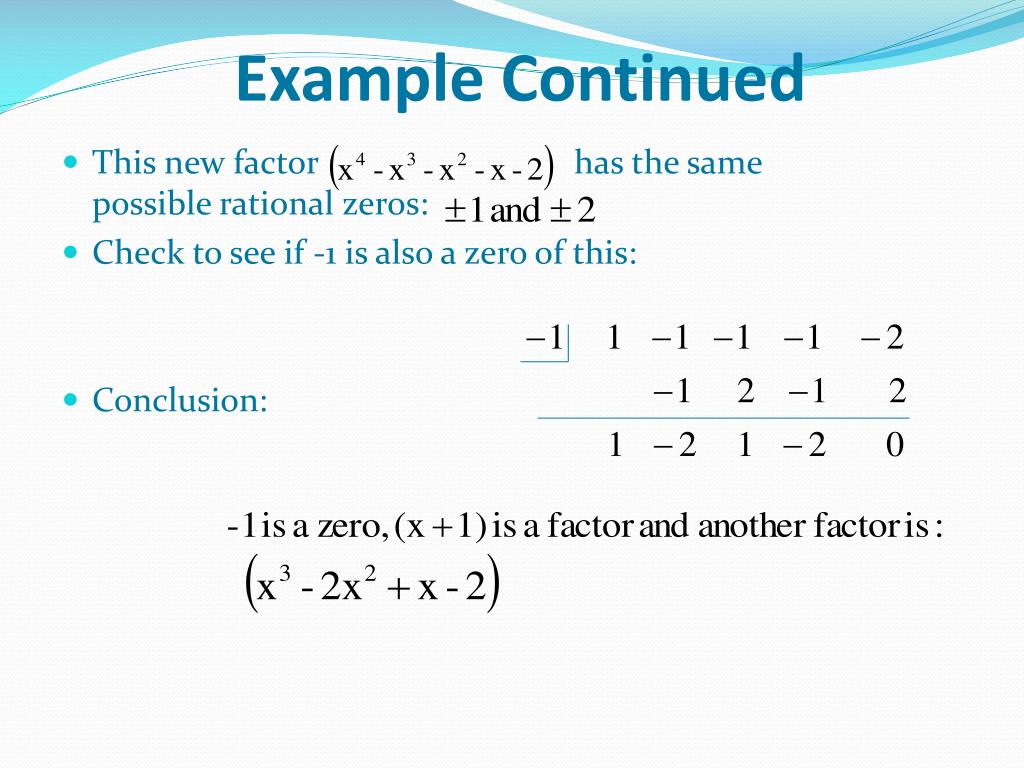
The following diagram shows how to use the rational root theorem. (𝑥 − 𝑐) is a factor of 𝑓(𝑥) if and only if 𝑓(𝑐) = 0. Tutorials, examples and exercises that can be downloaded are used to illustrate this theorem.
Recap We Can Use The Remainder & Factor Theorems To Determine If A Given Linear Binomial (𝑥 − 𝑐) Is A Factor Of A Polynomial 𝑓(𝑥).
It's always there when we need it, and it is easy to plug in. Example 2 find the roots of x3 +6x2 + 10x + 3 = 0. Testing these, we find that none are roots of the polynomial, and so it has no rational roots.
Show That If X X X Is A Positive Rational Such That X 2 + X X^2 + X X 2 + X Is An.
This means that substituting x = 1 + t yields a polynomial in t with constant term 1, while the coefficient of t3 remains the same as the coefficient of x3. The rational root theorem, or zero root theorem, is a technique allowing us to state all of the possible rational roots, or zeros, of a polynomial function. The leading coefficient is 2, with factors 1 and 2.
The Rational Root Theorem Describes A Relationship Between The Roots Of A Polynomial And Its Coefficients.
Specifically, it describes the nature of any rational roots the polynomial might possess. Therefore, root candidates that do not occur on both lists are ruled out. According to the integral root theorem, the possible rational roots of the equation are factors of 3.
What A Good Friend 1 Is.
A quick application of the rational root test gives us the following possible roots: We learn the theorem and see how it can be used to find a polynomial's zeros. Applying the rational root theorem thus yields the following possible roots for t:


Comments
Post a Comment